PDF p. 895 · 19-A-18
Leak Test
- 1.Install the vacuum gauge between the brake booster and check valve.
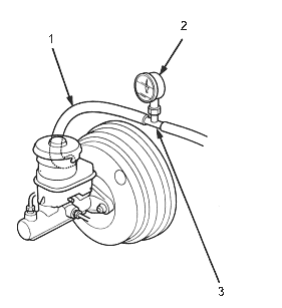
- 1. HOSE, Connect a hose of suitable diameter
- 2. VACUUM GAUGE, 07404-5790301
- 3. TUBE JOINT ADAPTOR, 07410-5790501
- 2.Start the engine, adjust the engine speed with the accelerator pedal so that the vacuum gauge readings show 40.0 - 66.7 kPa (300 - 500 mmHg, 11.8 - 19.7 in.Hg), then stop the engine.
- 3.
Read the vacuum gauge.
If the vacuum gauge reading decreases 2.7 kPa (20 mmHg, 0.8 in.Hg) or more after 30 seconds, check the following parts for leaks:
- Check valve
- Vacuum hose, pipe
- Seals
- Brake booster
- Master cylinder
NOTE: Do not try to disassemble the brake booster. Replace the brake booster as an assembly with a new one.
Function Test
- 1.Install the vacuum gauge the same way as in the leak test.
- 2.Connect the oil pressure gauges to the master cylinder using the attachments (special tools) as shown.
- 3.Bleed air through the valves.
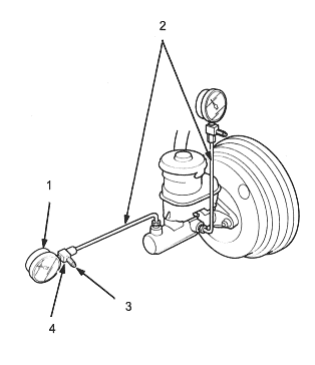
- 1. PRESSURE GAUGES, 07406-5790201
- 2. PRESSURE GAUGE JOINT PIPES, 07510-6340101
- 3. BLEED VALVES
- 4. PRESSURE GAUGE ATTACHMENT C, 07410-5790101
- 4.Start the engine and let it idle.
- 5.Have an assistant depress the brake pedal with a 98 N (10 kgf, 22 lbf) and 196 N (20 kgf, 44 lbf) pressure.
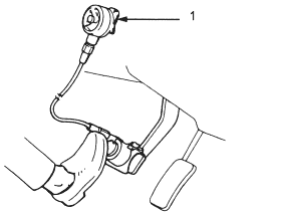
- 1. PRESSURE GAUGE, (Commercially available)
PDF p. 896 · 19-A-19
- 6.The following pressures should be observed at the pressure gauges in each vacuum.
| Vacuum kPa | N | kPa | ||||
| (mmHg, in.Hg) | (kgf, lbf) | (kgf/cm2, psi) | ||||
| 0 (0, 0) | 98 (10, 22) | 0 (0, 0) | ||||
| 294 (30, 66) 1,400 (14, 199) | ||||||
| 66.7 (500, 19.7) | 98 (10, 22) | 3,600 (37, 526) | ||||
294 (30, 66) 9,000 (292, 1,308)
- 7.Inspect the master cylinder for leaks if the readings do not fall within the limits shown above.
Check Valve Test
- 1.Disconnect the brake booster vacuum hose at the booster.
- 2.Start the engine and let it idle. There should be vacuum available. If no vacuum is available, the check valve is not working correctly. Replace the check valve and retest.
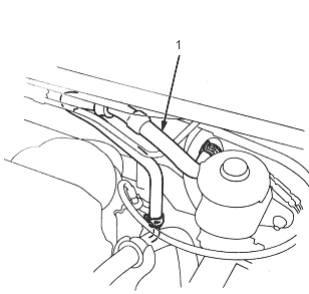
- 1. BRAKE BOOSTER VACUUM HOSE, (Check valve built-in)