PDF p. 1119 · 23-B-2
Battery Test
- Battery fluid (electrolyte) contains sulfuric acid. It may cause severe burns if it gets on your skin or in your eyes. Wear protective clothing and a face shield.
- If electrolyte gets on your skin or clothes, rinse it off
with water immediately.
- If electrolyte gets in your eyes, flush it out by splashing
water in your eyes for at least 15 minutes; call a physician immediately.
- A battery gives off hydrogen gas. If ignited, the hydrogen will explode and could crack the battery case and splatter acid on you. Keep sparks, flames and cigarettes away from the battery.
- Overcharging will raise the temperature of the electrolyte. This may force electrolyte to spray out of the battery vents. Follow the charger manufacturer's instructions and charge the battery.
NOTE:
- To get accurate results, the temperature of the electrolyte must be between 21 and 38 degrees centigrade (70 and 100 degrees F) before testing.
- The ECM memory must be reset after reconnecting the battery (see section 11).
Test Equipment Required:
Battery Tester with:
Voltmeter with 0 - 18V scale, ammeter with 0 - 100A and 0 - 500A scales and a carbon pile with 0 - 300W.
12V Battery Charger:
Fast charge capability of 50A and slow charge capability of 5A.
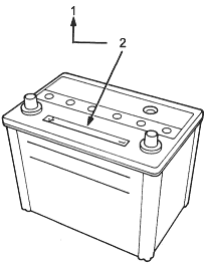
- 1. 55 B24L (S) - MF
- 2. BATTERY CODE
Test procedure:
- 1.Check for damage. If the case is cracked or the terminals are loose, replace the battery.
- 2.Check indicator (for basic charge conditions): Blue or green is OK. If the indicator is red, peel the tape off, remove the caps and add distilled water; then reinstall the caps and tape. If the indicator is clear, go to step 3.
- 3.
Test battery load capacity by connecting a battery tester and applying a load of three times the battery ampere hour rating.
When the load has been applied for exactly 15 seconds, the battery voltage reading should stay above 9.6V.
- If the reading stays above 9.6V, the battery is OK, clean its terminals and case and reinstall it.
- If the reading is between 6.5 and 9.6V, connect a battery charger and charge the battery for three minutes at an initial rate of 40 amps.
- Watch the battery voltage during the entire three minutes; the highest reading should stay below 15.5V.
- If the reading stays below 15.5V, the battery is OK; clean its terminals and case and reinstall it.
- If the reading exceeds 15.5V any time during the three minutes of fast charge, the battery is not good, replace it.
- If the reading drops below 6.5V, slow-charge the battery by connecting a battery and charge at 5 amps for no more than 24 hours (or until the indicator shows full charge, or the specific gravity of the electrolyte is at least 1.270). Then test load capacity again.
- If the voltage stays above 9.6V, the battery is OK; clean its terminals and case and reinstall it.
- If the voltage still drops below 6.5V, the battery is not good; replace it.