PDF p. 1683 · 8-3
The 3-coat-3-bake (3C-3B) paint finishes give the HR-V a deep gloss and stunning finish. This manual provides information on paint defect, repair and refinishing. Throughout, the objective is to explain in a simple yet comprehensive manner the basic items you should know about paint repairs. Select the correct material for the defect and repaint or refinish in the correct manner as described in this manual.
Basic Rules for Repairing a Paint Finish
To repair paint damage, always use the 2-part acrylic urethane paints designated; polish and bake each of the three coats, as in production to maintain the original film thickness, and so assure the same quality as the original finish.
Outline of Factory Painting Process:

Features in Each Work Process
- 1.
Pretreatment and Electrodeposition
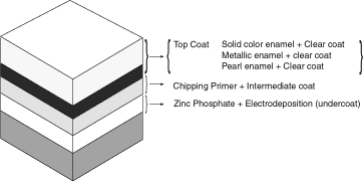
In the pretreatment process, the entire body is degreased, cleaned and coated with zinc phosphate by dipping.
After the body has been cleaned with pure water, it is placed in an electrolytic bath of soluble primer (Cationic Electrodeposition). This produces a thorough corrosion inhibiting coating on the inner surface and corners of the body, pillars, sills and panel joints. Chipping primer is then applied to the most susceptible areas (see page 8-11).
- 2.
Intermediate coat
The intermediate coat is applied to the prepared surface for further protection against damage.
- 3.
Top coat
Enamel paint and either polyester or acrylic resin paint are used in the top coat for higher solidity, smoothness, brightness and weather resistance.
Sectional View of Paint Coats: