PDF p. 737 · 15-6
Forward Start and Acceleration (4WD)
During a forward start and forward acceleration, the dual pump system can engage four wheel drive.
If the front wheels spin faster than the rear wheels, the front oil pump spins faster than the rear oil pump. The front pump draws fluid through check valve B and discharges it. Some of the discharged fluid is drawn in by the rear oil pump. The remaining fluid will pass through check valve E into the clutch piston, there, hydraulic pressure is regulated by two orifices. The regulated hydraulic pressure at the clutch piston pushes the plates and discs of the clutch together to form a connection. The engaged clutch then passes driving force from the transfer case to the rear wheels, producing 4WD.
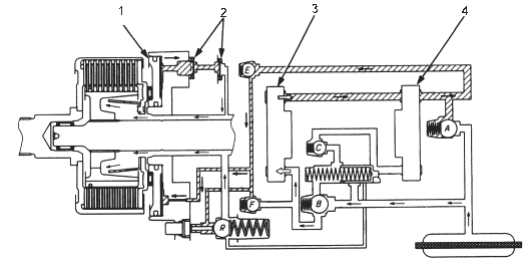
- 1. CLUTCH PISTON
- 2. ORIFICES
- 3. FRONT OIL PUMP
- 4. REAR OIL PUMP
Forward Driving at Constant Speed (2WD)
When driving forward at a constant speed (cruising), the dual pump system functions in two wheel drive mode.
The rotation speed of the front and rear wheels is the same, so the speed of the front and rear pumps is also the same. Fluid discharged by the front oil pump is drawn in by the rear oil pump and is circulated through the system. Because there is no pressure built up at the clutch piston, the clutch does not engage and the vehicle remains in 2WD (front wheel drive).
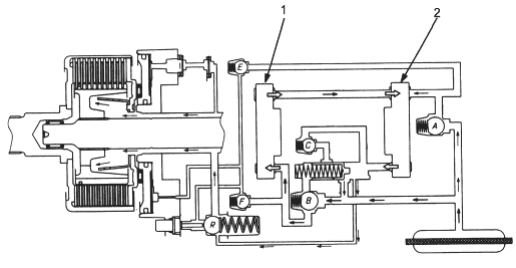
- 1. FRONT OIL PUMP
- 2. REAR OIL PUMP
PDF p. 738 · 15-7
Forward Deceleration (2WD)
During a forward deceleration, the dual pump system functions in two wheel drive mode.
Because of the braking characteristics, the speed of the rear wheels may exceed the speed of the front wheels during deceleration. If so , the rear oil pump spins faster than the front oil pump.
Fluid discharged by the rear oil pump is simply drawn in again by the rear pump and recirculated. Because there is no pressure built up at the clutch piston, the clutch piston does not engage and the vehicle remains in 2WD (front wheel drive).
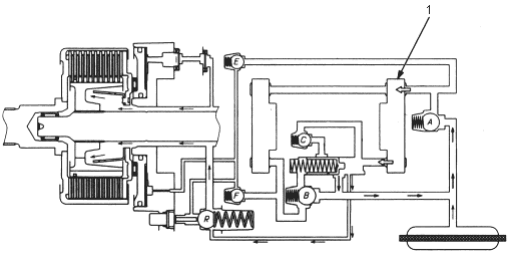
- 1. REAR OIL PUMP
Reverse Driving and Acceleration (4WD)
During reverse start and reverse acceleration, the dual pump system can engage four wheel drive.
If the front wheels spin faster than the rear wheels, the front oil pump spins faster than the rear oil pump. The front oil pump draws in fluid through check valve A and discharges it. (Note that in reverse, the direction of the pumps is the opposite of that during forward driving.)
Some of the fluid that is discharged by the front oil pump is drawn in by the rear oil pump. The remaining fluid passes through check valve F into the cylinder of the clutch piston, where it is regulated by two orifices.
The regulated hydraulic pressure at the clutch piston may force the plates and discs of the clutch together to form a connection. The engaged clutch passes driving force from the transfer case to the rear wheels, producing 4WD.
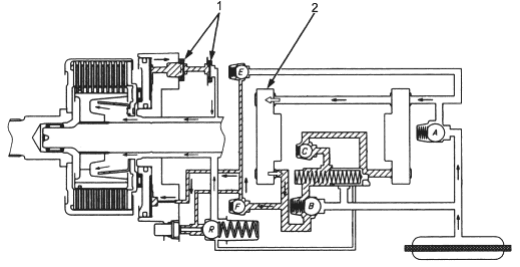
- 1. ORIFICES
- 2. FRONT OIL PUMP
PDF p. 739 · 15-8
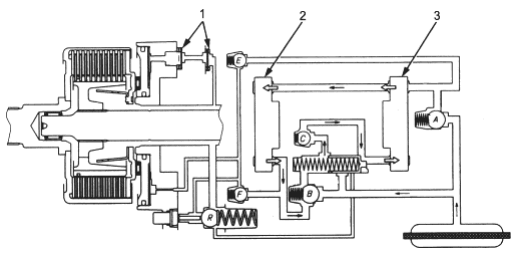
Reverse Driving at Constant Speed (2WD)
When driving in reverse at a constant speed, the dual pump system functions in two wheel drive mode.
The rotation speed of the front and rear wheels is the same, so the speed of the front and rear pumps is also the same.
Fluid discharged by the front oil pump is drawn in by the rear oil pump and is circulated through the system, but, because there is a difference in the capacity between the two pumps, fluid flows through check valve E and then through orifices. This fluid lubricates and cools the clutch assembly and bearings.
In this condition, only a low pressure is built up at the clutch piston, therefore, the clutch does not engage and the vehicle remains in 2WD (front wheel drive).
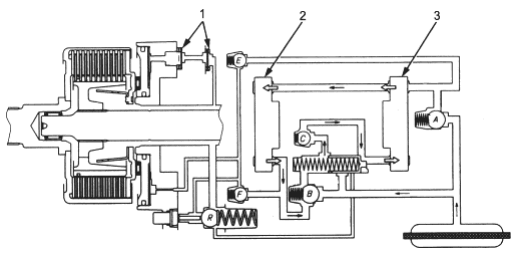
Reverse Deceleration (4WD)
During reverse deceleration, the dual pump system can engage four wheel drive.
- 1.ORIFICES
- 2.FRONT OIL PUMP
- 3.REAR OIL PUMP
When decelerating in reverse direction, the speed of the rear wheels may exceed the speed of the front wheels (due to engine braking). In this condition, the rear oil pump draws fluid through check valves B and C. Fluid discharged from the rear oil pump then flows through check valve E to the clutch piston, there, pressure is regulated by two orifices.
The regulated hydraulic pressure at the clutch piston may force the plates and discs of the clutch together to form a connection. The engaged clutch passes driving force from the transfer case to the rear wheels, producing 4WD.
- 1. ORIFICES
- 2. REAR OIL PUMP
PDF p. 740 · 15-9
Thermal Switch Operation (2WD)
During 4WD operation, pressure-regulated fluid is in contact with the clutch piston and the thermal switch.
If the temperature of the fluid in the differential goes to high, the thermal switch pushes open the relief valve R. This causes the pressure in the clutch piston to drop and 4WD mode is disengaged.
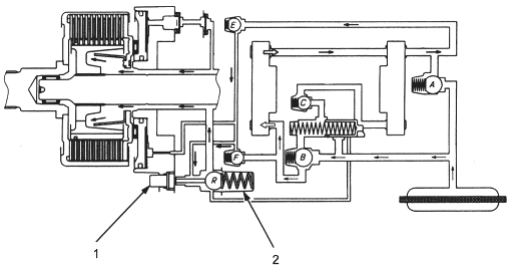
- 1. THERMAL SWITCH
- 2. RELIEF VALVE
Relief Valve Operation
When the fluid pressure goes higher than the relief valve spring force, check valve r opens. Pressure applied at the clutch piston is held constant. This feature adds stability by preventing the rear wheel drive system from experiencing excessive torque.
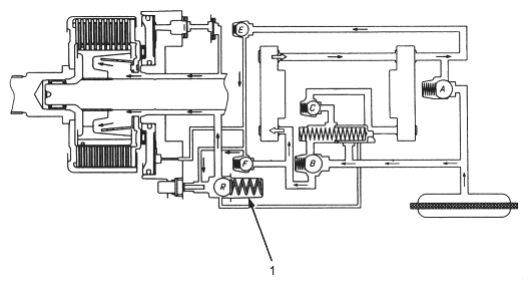
- 1. RELIEF VALVE