PDF p. 1902 · 11-121
- 1.Remove the fuel fill cap.
- 2.Remove the vapour line from the two way valve on the fuel tank and connect to the T-fitting from the vacuum gauge and vacuum pump as shown.
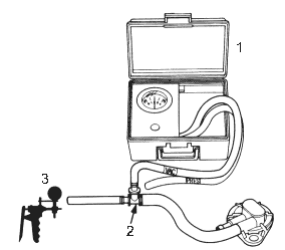
- 1. VACUUM/PRESSURE GAUGE
- 2. T-FITTING
- 3. VACUUM PUMP/GAUGE
- 3.
Apply vacuum slowly and continuously while watching the gauge.
Vacuum should stabilise momentarily at 0.7 - 2.0 kPa (5 - 15mmHg, 0.2 - 0.6 in.Hg).
- If vacuum stabilises (valve opens) below 0.7 kPa (5 mmHg, 0.2 in.Hg) or above 2.0 kPa (15 mmHg, 0.6 in.Hg), install a new valve and retest.
- 4.Move vacuum pump hose from vacuum to pressure fitting, and move vacuum gauge hose from vacuum to pressure side as shown.
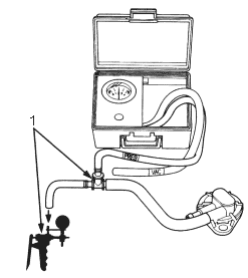
- 1. PRESSURE SIDE
- 5.
Slowly pressurise the vapour line while watching the gauge.
Pressure should stabilise at 1.3 - 4.7 kPa (10 - 35 mmHg, 0.4 - 1.4 in.Hg).
- If pressure momentarily stabilises (valve opens) at 1.3 - 4.7 kPa (10 - 35 mmHg, 0.4 - 1.4 in.Hg), the valve is OK.
- If pressure stabilises below 1.3 kPa (10 mmHg, 0.4 in.Hg) or above 4.7 kPa (35 mmHg, 1.4 in.Hg), install a new valve and retest.