How to Use This Manual
This manual covers the repair of a 1999 HR-V that has been involved in an accident, and it describes the work related to the replacement of damaged body parts. Please read through these instructions and familiarize yourself with them before actually using this manual.
NOTE: Refer to the 1999 HR-V Shop Manual, P/N 62S2H00, for specifications, wire harness locations, safety stand support points etc.
Special Information
⚠ WARNING : Indicates a strong possibility of severe personal injury or loss of life if instructions are not followed.
⚠ CAUTION : Indicates a possibility of personal injury or equipment damage if instructions are not followed.
NOTE: Gives helpful information.
All information contained in this manual is based on the latest product information available at the time of printing. We reserve the right to make changes at any time without notice. No part of this publication may be reproduced, stored in retrieval system, or transmitted, in any form by any means, electronic, mechanical, photocopying, recording, or otherwise, without the prior written permission of the publisher. This includes text, figures and tables.
| First Edition 12/98 | 140 pages | HONDA MOTOR CO., LTD. |
| All Rights Reserved | Service Publication Office | |
Service Precautions
Supplemental Restraint System (SRS)
This model has an SRS which includes a driver’s airbag located in the steering wheel hub and some types include a passenger’s airbag located in the dashboard above the glove box and seat belt tensioners located in the seat belt retractors. The SRS (Type III) unit is not part of the airbag assembly and has built-in sensors.
NOTE: The following precautions should be observed when performing sheet metal work, paint work and repair work around the locations of the SRS components.
- 1.The SRS unit (including safe sensor and impact sensor) is located under the dashboard. Avoid any strong impact with a hammer or other tools when repairing the front side frame and the lower part of the dashboard. Do not apply heat to these areas with a torch, etc.
- 2.Take extra care when painting or doing body work in the area below the centre pillar. Avoid direct exposure of the seat belt retractor with tensioners to heat guns, welding, or spraying equipment.
- 3.All SRS electrical wiring harnesses are located under the lowest part of the dashboard below the dashboard panel. (All SRS electrical wiring harnesses are indicated by yellow colour coding.) Care should be taken not to damage the harness when repairing this area.
- 4.Do not apply heat of more than 100°C (212°F) when drying painted surfaces anywhere around the locations of SRS components.
- 5.If strong impact or high temperature needs to be applied tot he areas around the locations of SRS components, remove the components before performing the repair work.
- 6.If any of the SRS related components are damaged or deformed, be sure to replace them.
NOTE: Refer to Restraints section of the Shop Manual for removal and replacement of SRS related components.
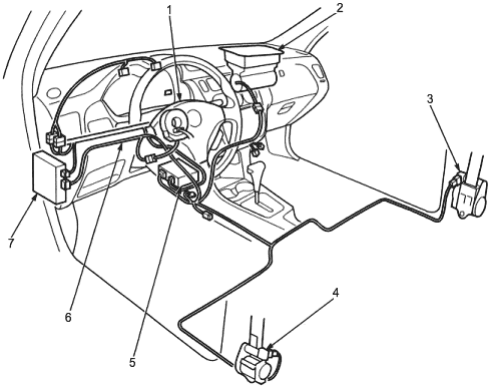
General Safety Precautions
Before beginning work:
- Disconnect the battery to reduce the possibility of fire caused by electrical shorts.
- Check for fuel leaks and repair as necessary.
- 1.DRIVER’S AIRBAG ASSEMBLY
- 2.FRONT PASSENGER’S AIRBAG ASSEMBLY
- 3.
FRONT PASSENGER’S SEAT BELT RETRACTOR
(With tensioner)
- 4.DRIVER’S SEAT BELT RETRACTOR (With tensioner)
- 5.
SRS UNIT
(With built-in sensor)
- 6.
SRS MAIN HARNESS
(Indicated by yellow colour coding)
- 7.UNDER-DASH FUSE/RELAY BOX
- Remove the fuel tank and/or fuel lines if welding equipment is to be used near the fuel system.
- Before welding, sanding or cutting, protect carpets and seats with fire-proof covers.
Use standard safety equipment when spraying paint, welding, cutting, sanding or grinding. Standard safety equipment includes:
Respirator and filter masks - Designed to filter out toxic fumes, mist, dust or other airborne particles. Use a respirator of filter mask designed to protect you from the hazards of the particular job; some respirators, for example, are designed to filter out only dust and airborne particles not toxic fumes.
Safety goggles or glasses - Designed to protect your eyes from projectiles, dust particles or splashing liquid.
Gloves - Rubber gloves protect against corrosive chemicals. Welding gloves protect against burns and abrasions caused by welding, sanding or grinding.
Safety shoes - Non-slip soles protect against slipping. Metal tow inserts protect against falling objects.
Ear plugs - Protect eardrums from harmful noise levels.
During work:
- Do not smoke while working near the fuel system.
- Deposit gas or solvent-soaked shop towels in an approved container.
- Always attach a safety cable when using a hydraulic ram or a frame straightening table; do not stand in direct line with the chains used on such equipment.
- Follow standard safety practices when using toxic or flammable liquids.